First Book of Tracing Color Book, KDP
The First Book of Tracing Color Book, KDP is a purpose-built, print-ready resource designed for creators and educators developing early literacy materials—especially those publishing on Amazon’s Kindle Direct Publishing (KDP) platform. It’s not a generic coloring book or a broad-strokes activity pack. Rather, it’s a tightly scoped, production-ready tracing workbook focused on foundational handwriting development: uppercase and lowercase letter formation, line control, pre-writing shapes, and simple thematic illustrations (e.g., animals) that support engagement without distracting from motor skill goals. At its core, this asset serves two practical functions: as a ready-to-upload KDP interior file and as a flexible design foundation for custom adaptations.
What Makes This Tracing Workbook Stand Out in Practice
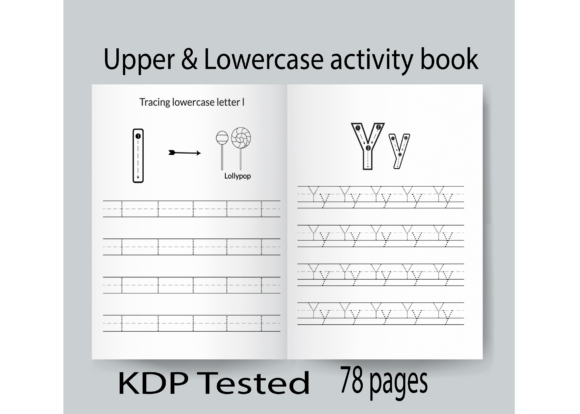
Unlike many digital tracing resources that prioritize volume over pedagogical coherence, the First Book of Tracing Color Book, KDP balances structure with usability. Its 78-page composition includes 26 core worksheet pages—each sized to standard 8.5 x 11 inches—and is supplemented by high-resolution source files: 78 PNGs and 28 JPGs. That granular asset breakdown matters. PNGs preserve clean vector-like edges essential for crisp letter tracing lines; JPGs offer lightweight alternatives for preview thumbnails or web use. All files are print-optimized, meaning no scaling artifacts, no blurry strokes, and consistent line weights across letters and guides.
The tracing progression follows a logical sequence: starting with horizontal, vertical, and diagonal line practice; moving into curves and ovals; then introducing uppercase letters (with directional arrows and dashed guides); followed by lowercase counterparts. Each letter appears in isolation—not embedded in words or sentences—keeping cognitive load low for preschoolers and early kindergarten learners. Animal-themed pages (e.g., “Trace the lion’s mane,” “Follow the turtle’s shell”) integrate visual interest while maintaining focus on controlled hand movement. These aren’t decorative flourishes—they’re functional anchors that sustain attention during repetitive motor tasks.
Real-World Usability for Creators and Educators
In actual use, the First Book of Tracing Color Book, KDP performs well where many similar assets fall short: consistency and adaptability. The stroke thickness remains uniform across all 52 letters, avoiding the common issue of uneven guide lines that confuse young learners or require manual correction in editing software. Arrows indicating stroke direction are consistently placed and sized—critical for building correct muscle memory. As a KDP upload, it requires minimal prep: the PDF meets Amazon’s bleed and margin specifications out of the box, and the 300 DPI resolution ensures sharp printing even at bulk order volumes.
For educators using printed copies in classrooms or therapy settings, the layout allows for selective photocopying. You don’t need to print all 78 pages—just the uppercase A–M set for a small group, or the animal-themed pages for a themed learning station. The absence of answer keys or teacher notes isn’t a flaw here; it reflects the product’s intended role as a raw, neutral tool—not a scripted curriculum. That neutrality gives professionals room to layer in their own scaffolding: verbal prompts, tactile overlays (e.g., sandpaper letters), or fine motor warm-ups before each session.
Who Benefits Most—and When
This resource delivers strongest value to three overlapping groups:
- KDP publishers targeting the preschool-to-kindergarten niche: If your goal is launching multiple low-maintenance, high-demand workbooks (e.g., “Tracing Letters + Numbers,” “Back-to-School Fine Motor Bundle”), the First Book of Tracing Color Book, KDP provides a reliable, tested interior template. Its structure reduces design time significantly—no need to redraw arrow guides or reposition baseline dots.
- Early childhood educators and occupational therapy assistants: Those sourcing supplemental, reproducible materials for mixed-age groups appreciate the clean, uncluttered design. It avoids cartoonish overload common in mass-market books—making it suitable for learners with sensory sensitivities or attention challenges.
- Freelance designers and content creators building custom curricula: The inclusion of layered PNG and JPG source files means you can recolor letters, add bilingual labels, insert phonics cues, or embed into interactive PDFs—all without starting from scratch.
It’s less suited for users needing full lesson plans, assessment rubrics, or multisensory extensions (e.g., QR-linked audio models). Nor does it include editable text layers—so modifying instructions or adding translations requires graphic editing proficiency. That’s not a limitation but a boundary: this is a production asset, not an authoring platform.
Quality, Reliability, and Long-Term Utility
Print fidelity holds up across paper stocks—from standard copy paper to premium matte finishes. Line clarity remains intact even when photocopied multiple generations, a practical advantage for classroom reuse. The grayscale-friendly design (no reliance on color-coding for instruction) ensures accessibility and cost-effective printing. From a workflow perspective, having both PDF and raster source files eliminates dependency on a single format—use the PDF for direct KDP submission, PNGs for Canva-based social media teasers, and JPGs for email previews.
Long-term, its utility lies in modularity. You can extract individual letters to build flashcards, convert animal pages into cut-and-paste sequencing activities, or combine tracing lines with dotted number paths for cross-skill reinforcement. Because the strokes follow conventional handwriting models (e.g., top-down for uppercase “L,” counterclockwise for “O”), it aligns with widely adopted curricula like Handwriting Without Tears or Getty-Dubay, easing integration into existing programs.
Practical Recommendations for Use
If you’re evaluating the First Book of Tracing Color Book, KDP for your project, consider these evidence-informed approaches:
- Start with the first 10 pages only: Introduce line and curve tracing for 5–7 minutes daily before advancing to letters. Rushing into alphabetic content too soon undermines pen control gains.
- Pair with physical tools: Use short golf pencils or triangular grip pens—not standard #2 pencils—to reinforce proper finger positioning. The workbook’s line weight (approx. 1.5 pt) responds well to light pressure, making it compatible with beginner-friendly writing instruments.
- Track progress visually: Photocopy one page weekly. Over time, compare stroke smoothness, baseline adherence, and letter proportion—not just completion. This reveals motor development more accurately than checkmarks alone.
- Repurpose strategically: Convert PNGs into SVGs for Cricut or Silhouette cutting machines to create tactile tracing boards, or import into Google Slides for guided virtual sessions with annotation tools.
Ultimately, the First Book of Tracing Color Book, KDP earns its place not through novelty, but through executional discipline: clear intent, consistent delivery, and respect for both learner needs and creator constraints. It doesn’t try to be everything. It does one thing—early handwriting scaffolding—well, and builds in the flexibility to extend that foundation thoughtfully. For professionals who prioritize reliability over hype, that precision is where real value begins.